
Why This Comparison Matters for Commercial ESS Buyers
A battery chemistry decision affects more than equipment selection. It influences:- how often the system can cycle
- how much usable energy is available each day
- how much space the installation requires
- how much maintenance the site team must handle
- how efficiently the system captures savings from peak shaving or time-of-use optimization
- how long the project can perform before major replacement is needed
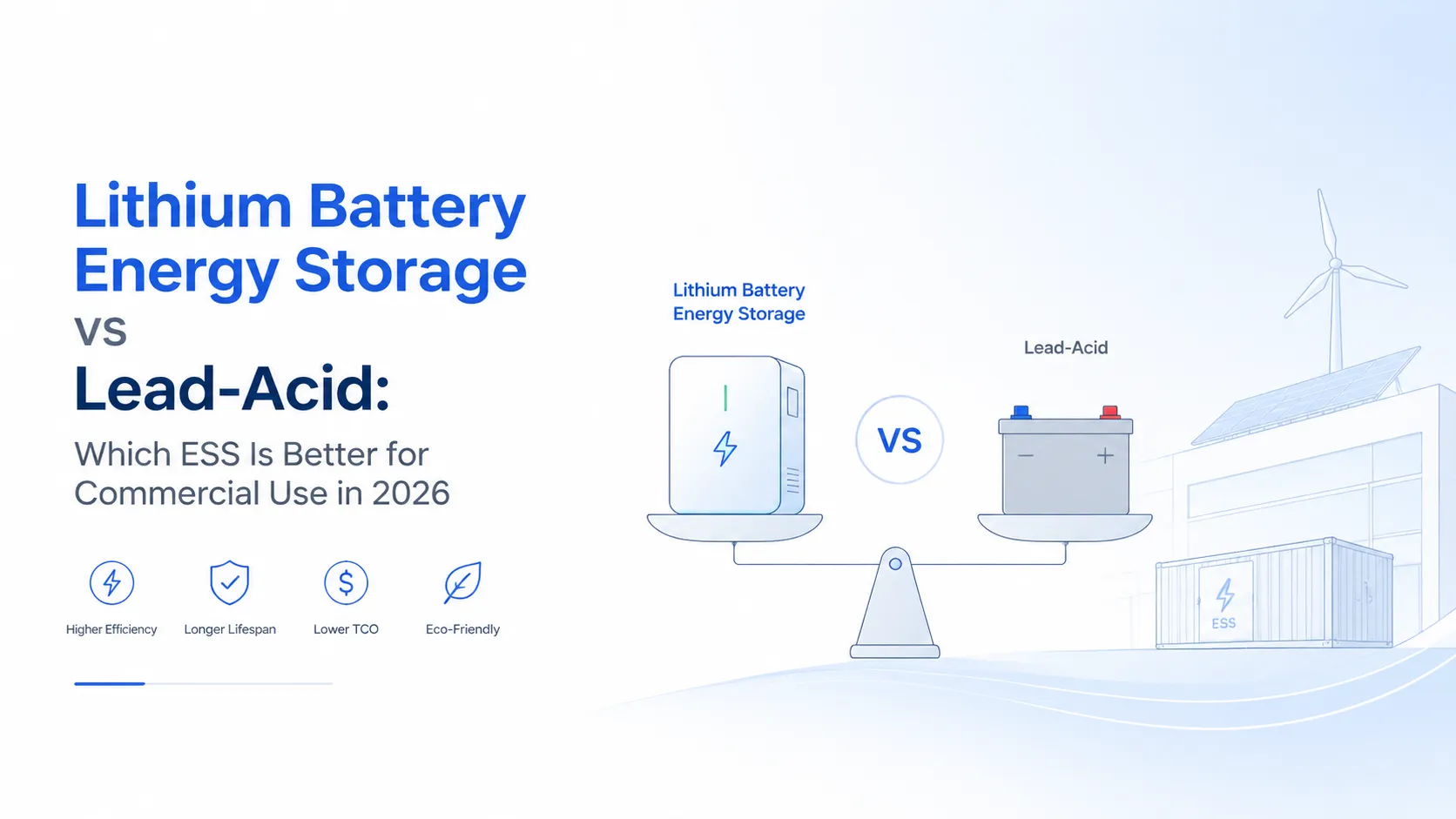
Lithium Battery Energy Storage vs Lead-Acid: The Core Differences
| Factor | Lithium Battery ESS | Lead-Acid ESS |
|---|---|---|
| Cycle capability | Better suited for frequent cycling and daily dispatch | Better suited for lighter cycling or backup-oriented use |
| Usable depth of discharge | Typically higher usable capacity | Often lower usable capacity if long life is required |
| Round-trip efficiency | Generally higher | Generally lower |
| Footprint and weight | More compact, higher energy density | Heavier and bulkier for the same usable energy |
| Maintenance needs | Usually lower routine maintenance | Often higher maintenance attention depending on system design |
| Project life strategy | Strong fit for optimization-driven ESS | Can fit lower-duty or budget-constrained projects |
Where Lithium Battery ESS Usually Performs Better
1. High-frequency cycling applications
If your business model relies on daily peak shaving, tariff arbitrage, solar self-consumption optimization, or repeated load shifting, lithium batteries usually offer a stronger fit. Commercial ESS projects often need regular dispatch over many years, and systems that can tolerate deeper and more frequent cycling tend to support better long-term economics.2. Space-constrained commercial sites
For rooftops, utility rooms, industrial compounds, and urban commercial sites, footprint matters. A more compact storage system can simplify layout, civil work, and integration with other electrical equipment.3. Lower maintenance burden
Many commercial buyers want predictable operation with limited on-site intervention. When the project owner values operational simplicity, lithium solutions are often easier to align with modern EMS-driven storage projects.4. Better support for optimization value streams
Projects that pursue demand charge reduction, solar-plus-storage coordination, backup integration, and energy management software benefits often favor lithium because the system is expected to operate dynamically, not just sit idle waiting for occasional outages.Where Lead-Acid Can Still Make Sense
1. Backup-focused applications with low cycling intensity
If the system is used mainly for reserve power and not for frequent daily dispatch, lead-acid may still be considered in some project scenarios.2. Projects with severe upfront budget constraints
Some buyers focus first on initial capex rather than lifecycle value. In those cases, lead-acid may appear attractive at the purchase stage, even if replacement intervals, usable capacity limits, and operational trade-offs reduce long-term competitiveness.3. Simpler applications with modest performance expectations
Where the project does not require advanced cycling strategy, high efficiency, or compact packaging, lead-acid can remain a practical but narrower option.What Commercial Buyers Often Miss in This Comparison
The biggest mistake is comparing nameplate cost alone. A better commercial evaluation should include:- usable energy rather than headline rated capacity
- expected operating profile such as daily cycling vs standby backup
- replacement risk over the project life
- maintenance labor and downtime exposure
- energy losses that affect realized savings
- space and balance-of-system impact
- integration with EMS, PCS, solar, and control strategy
Commercial ESS Decision Framework: Which One Is Better for Your Use Case?
Lithium is usually the better choice when:
- the system will cycle frequently
- you want demand charge reduction or tariff optimization
- space is limited
- you want a more modern, compact ESS architecture
- longer-term performance consistency matters more than lowest entry price
Lead-acid may still be acceptable when:
- the use case is mostly backup power
- cycling frequency is low
- capital budget is the main constraint
- the site can accept more space, weight, and maintenance burden
How This Affects ROI in 2026
In 2026, many commercial energy storage projects are judged by savings quality over time, not just battery acquisition cost. If a battery supports better dispatch performance, higher usable output, and lower operational friction, it may create a stronger total return profile even if the purchase price is higher. That is why chemistry selection should be connected to project modeling. Buyers should estimate:- annual savings potential from demand charge reduction
- time-of-use shifting value
- solar self-consumption improvement
- backup power value for critical loads
- expected degradation and replacement planning
- operating and maintenance costs
Our Recommendation for Most Commercial Buyers
For most modern C&I ESS projects in 2026, lithium battery energy storage is usually the stronger choice because it aligns better with high-cycle operation, tighter installation footprints, and software-driven energy optimization. Lead-acid still has a place in selected low-cycle or backup-heavy applications, but it is usually not the first-choice platform for advanced commercial ESS value capture. The best decision comes from matching chemistry to load profile, control strategy, available space, resilience goals, and expected payback model rather than choosing only by initial battery cost.FAQ
Is lithium better than lead-acid for commercial energy storage?
In many commercial ESS applications, yes. Lithium is often better suited to frequent cycling, higher usable capacity, smaller footprint requirements, and optimization-driven operating strategies. Lead-acid can still fit some low-cycle backup applications.Why do commercial buyers still consider lead-acid batteries?
Lead-acid may still be considered where upfront budget is the primary concern, cycling intensity is low, and the site mainly needs backup capability rather than daily energy optimization.Which battery type is better for peak shaving and demand charge reduction?
For most peak shaving and demand charge reduction projects, lithium is usually the better fit because these applications depend on repeated cycling, responsive control, and stronger long-term dispatch capability.Does lower upfront cost always make lead-acid the better value?
No. Commercial buyers should compare lifecycle value, including usable energy, efficiency, maintenance, replacement timing, and operating flexibility. A lower purchase price does not automatically mean lower total project cost.How should I choose the right ESS battery chemistry for a commercial project?
Start with the use case: backup, daily peak shaving, solar integration, tariff shifting, or mixed operation. Then compare footprint, cycle expectations, maintenance capacity, and ROI targets before choosing the battery platform.Specifying LFP for your project? See Luminvolt’s battery energy storage systems (BESS) for C&I and utility applications.