
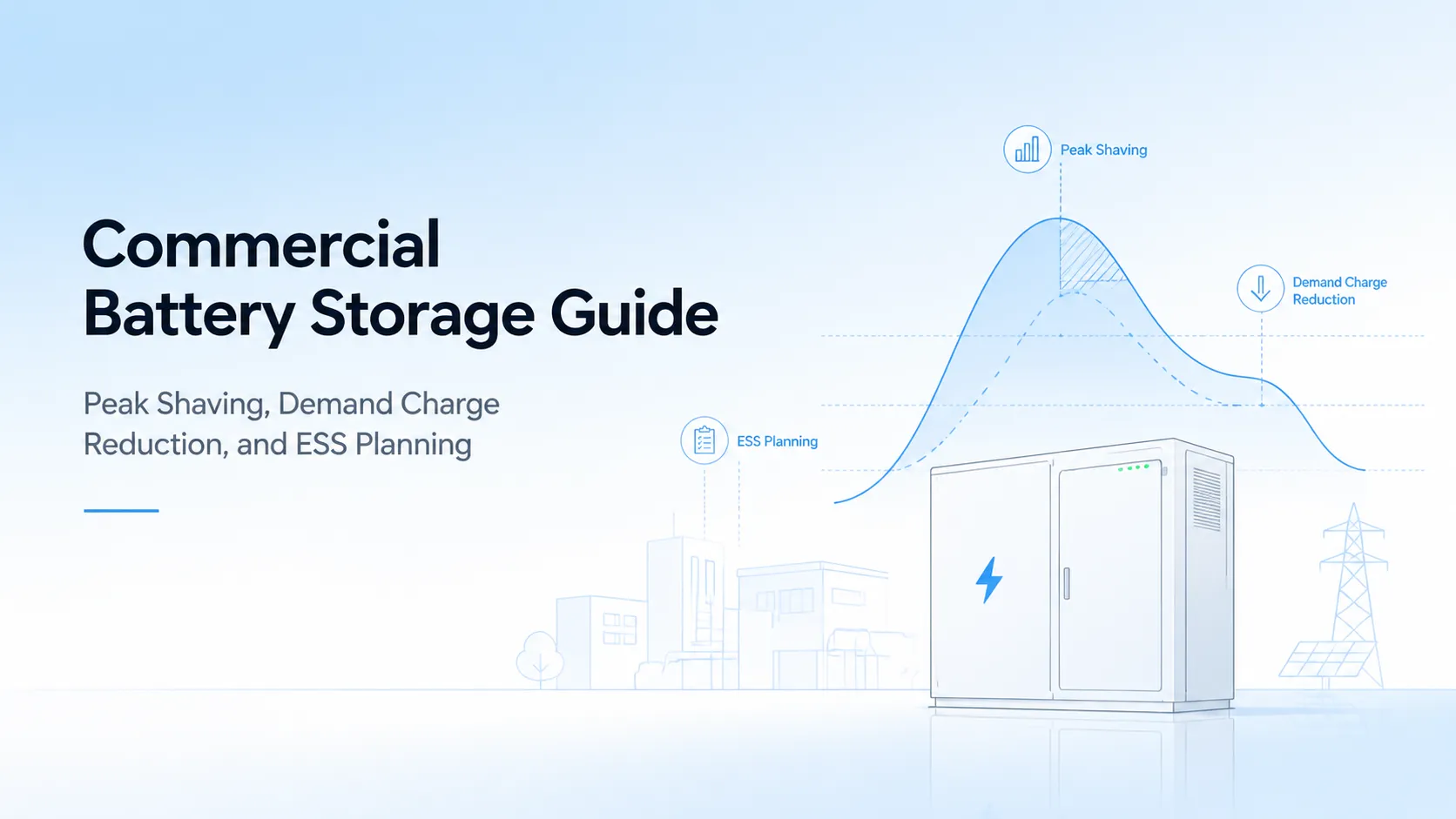
Commercial battery storage is becoming a strategic asset for factories, office parks, farms, schools, logistics sites, and other power-intensive facilities. Instead of using batteries only as emergency backup, businesses now deploy energy storage to reduce peak demand, optimize tariffs, improve resilience, and support on-site solar generation.
If you are planning a C&I project, this guide explains how commercial ESS value is created and how to connect site-level planning with a broader energy storage system solution framework.
What Is Commercial Battery Storage?
Commercial battery storage refers to battery energy storage systems deployed for business, institutional, and industrial loads. These systems are often larger and more control-driven than residential batteries. They typically integrate battery racks, PCS/inverters, transformers, EMS software, fire protection, and site-specific interconnection design.
How Commercial ESS Creates Financial Value
- Peak shaving: Reduce the highest demand intervals that drive utility charges.
- Demand charge reduction: Lower monthly bills by clipping large load spikes.
- Load shifting: Charge during lower-cost periods and discharge during expensive windows.
- Solar optimization: Store excess PV energy instead of curtailing or exporting at lower value.
- Resilience: Support critical loads and improve continuity for operations.
Peak Shaving vs. Backup Power: Different Design Priorities
Many buyers assume commercial battery storage is mostly about backup power, but that is often only one part of the business case. A project designed for peak shaving may prioritize fast response, dispatch logic, and tariff windows. A project designed for resilience may prioritize critical-load segmentation, transfer logic, and outage duration.
| Objective | Primary Design Focus |
|---|---|
| Peak shaving | Demand profile analysis, dispatch logic, inverter power, cycle frequency |
| Demand charge reduction | Billing structure, recurring peak events, control precision |
| Backup resilience | Critical loads, autonomy, islanding strategy, transfer design |
| Solar + storage | PV production profile, export rules, self-consumption value |
Key Inputs for Commercial Battery Storage Planning
- 15-minute or finer interval load data
- Utility tariff structure and demand charge components
- Critical vs. non-critical load segmentation
- Existing or planned solar PV capacity
- Available installation space and grid interconnection constraints
- Target payback period and operating strategy
Without interval data, many projects are sized too loosely. Real ESS planning starts with the load curve, because the commercial value of storage depends on when power is needed, not just how much energy a site uses in total.
When to Use a Dedicated C&I ESS Instead of a Residential-Style Battery
Commercial sites should not evaluate storage like households do. Larger loads, higher fault levels, operating complexity, and tariff structures require a more engineered platform. If your use case involves multiple buildings, manufacturing equipment, or coordinated power management, you are likely in dedicated C&I ESS territory.
For readers comparing home and business use cases, see our residential energy storage system guide. For detailed system architecture context, review ESS working principles and the LuminPack product page.
FAQ: Commercial Battery Storage
What data should I collect before sizing a commercial ESS?
Start with interval load data, utility tariffs, outage requirements, and any solar generation data. These inputs determine whether the project is driven by demand charges, resilience, or solar optimization.
Is commercial battery storage only for factories?
No. Offices, schools, farms, retail sites, data-heavy facilities, and logistics parks can also benefit when tariffs, outage risks, or on-site solar economics support storage.
What is the most common planning mistake?
The most common mistake is evaluating storage only by battery capacity without modeling demand peaks, tariff windows, and the actual dispatch strategy needed to unlock savings.
Commercial battery storage works best when it is aligned with real operating data, tariff structures, and resilience goals. If you want to see where this topic fits in the broader content cluster, start from the main energy storage system pillar page.