
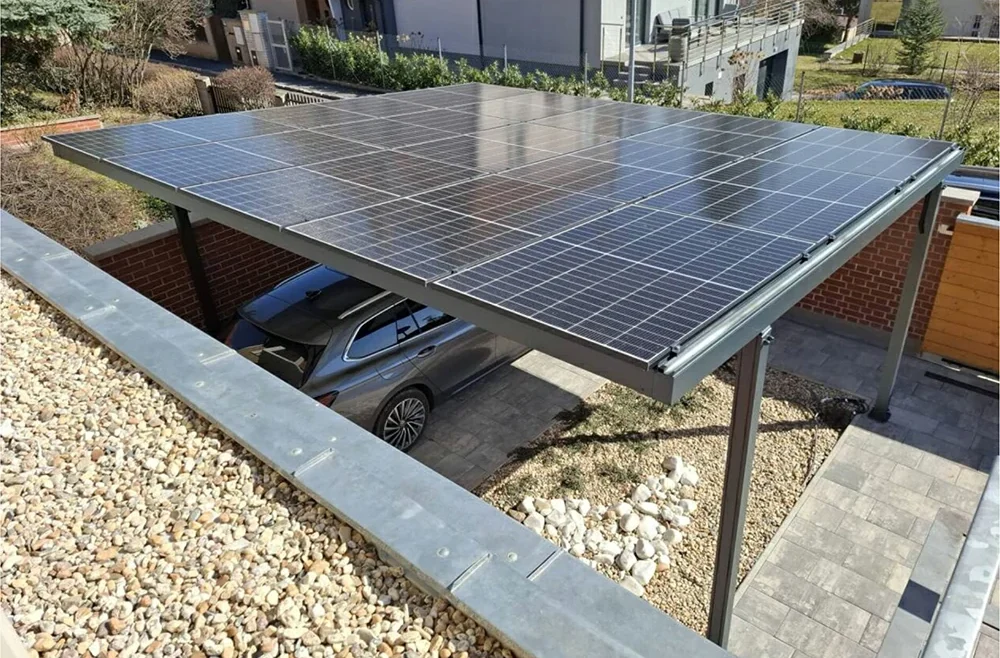
Solar self-consumption is the share of photovoltaic (PV) electricity that a home or business uses on-site instead of exporting to the grid. Raising that share can improve the value of a PV system, but a higher percentage is not automatically better. The right target depends on the load profile, retail electricity price, export credit, system size, and cost of any battery or control equipment.
This guide shows you how to calculate solar self-consumption correctly, distinguish it from self-sufficiency, estimate its financial value, and choose practical ways to increase it. The methods work for homes, small businesses, and commercial PV projects.
Quick answer
Self-consumption rate = solar electricity used on-site ÷ total solar electricity generated × 100. Start by shifting flexible loads into solar hours. Then model smart controls, EV charging, hot-water heating, and battery storage against interval data before buying equipment.
What Is Solar Self-Consumption?
Solar self-consumption is the PV electricity consumed at the same property where it is produced. It can flow directly from the inverter to active loads, or it can be stored in a battery and used later. Electricity exported to the grid is not self-consumed.
A grid-connected system usually follows this order: solar first supplies active loads, surplus solar charges a battery if one is available, and the remaining surplus goes to the grid. When solar output falls below demand, the battery may discharge before the property imports electricity.
The self-consumption formula
For a system without a battery, calculate direct solar use for each metering interval:
Direct solar use for an interval = the lower of PV generation or site demand
Add the intervals for the month or year, then divide the result by total PV generation. Fifteen-minute or hourly data gives a meaningful result. Comparing annual generation with annual demand does not show whether production and consumption occurred at the same time.
Self-consumption vs. self-sufficiency
| Metric | Formula | Question it answers |
|---|---|---|
| Self-consumption rate | On-site solar use ÷ PV generation | How much of our solar production stays on-site? |
| Self-sufficiency rate | On-site solar use ÷ total electricity demand | How much of our demand is supplied by solar? |
| Export rate | Exported solar ÷ PV generation | How much solar goes to the grid? |
| Grid-dependence rate | Grid imports ÷ total demand | How much demand still comes from the grid? |
These metrics can move in opposite directions. A small PV array serving a steady daytime load may reach high self-consumption while covering only a small part of annual demand. A large array may cover more demand but export a larger share of its output.
How to Calculate Solar Self-Consumption
The most reliable method compares PV generation and electricity demand in matching time intervals. Use at least one representative year when possible, because weekday, weekend, and seasonal patterns can differ sharply.
Step 1: Collect the right data
- Download 12 months of 15-minute, 30-minute, or hourly consumption data from the smart meter or utility portal.
- Export PV generation data from the inverter monitoring platform for the same dates and intervals.
- Check that both datasets use the same time zone and interval boundaries.
- Separate grid imports, PV generation, battery charge, battery discharge, and grid exports where those channels are available.
If the system has not been built, estimate generation with a bankable simulation tool. The European Commission’s PVGIS platform provides free PV production estimates and hourly output data for a wide geographic area. Use local engineering software where project contracts or permitting rules require it.
Step 2: Calculate every interval
For each row in a spreadsheet, set direct solar use equal to the smaller of generation and load. Export equals generation minus direct solar use. Grid import equals load minus direct solar use. Sum each column to obtain monthly and annual totals.
| Time | PV generation | Site demand | Direct solar use | Export | Grid import |
|---|---|---|---|---|---|
| 10:00–11:00 | 3.2 kWh | 2.0 kWh | 2.0 kWh | 1.2 kWh | 0 kWh |
| 11:00–12:00 | 4.0 kWh | 5.5 kWh | 4.0 kWh | 0 kWh | 1.5 kWh |
In Excel or Google Sheets, if PV generation is in cell B2 and load is in C2, direct solar use is =MIN(B2,C2). Export is =MAX(B2-C2,0), and grid import is =MAX(C2-B2,0).
Step 3: Include battery energy without double counting
With storage, count solar energy when it serves a load—not both when it charges the battery and when it leaves the battery. Total on-site solar use equals direct PV-to-load energy plus battery discharge attributable to solar charging. Battery and inverter losses remain losses; they do not serve site demand.
A proper storage model must also track state of charge, usable capacity, charge and discharge power, minimum state of charge, and conversion efficiency. The U.S. Department of Energy explains that storage can move solar energy to periods when it is needed, including evenings and outages, in its overview of solar energy and storage integration.
Worked Example: A 10,000 kWh PV System
Consider a property that generates 10,000 kWh of solar electricity and consumes 8,000 kWh over one year. Interval analysis shows the following energy flows:
| Annual energy flow | Value |
|---|---|
| Direct PV-to-load use | 3,200 kWh |
| Solar-charged battery discharge to loads | 2,000 kWh |
| PV export | 4,300 kWh |
| Storage and conversion losses | 500 kWh |
| Total on-site solar use | 5,200 kWh |
- Self-consumption rate: 5,200 ÷ 10,000 = 52%
- Self-sufficiency rate: 5,200 ÷ 8,000 = 65%
- Grid imports: 8,000 − 5,200 = 2,800 kWh
This example also shows why a battery does not make self-consumption plus export equal 100%. Some solar energy is lost during conversion and storage. Curtailment may create another difference on systems with export limits.
What Is a Good Solar Self-Consumption Rate?
A good solar self-consumption rate is one that produces the strongest project value after equipment, energy losses, tariffs, and operating needs are considered. There is no universal target. A high percentage can result from an undersized array, while a lower percentage can still be profitable where exports receive fair compensation.
- Homes empty during the day: Direct self-consumption may be limited unless loads move into solar hours or storage is added.
- Offices and retail sites: Daytime demand often aligns well with PV output.
- Factories: A stable daytime base load can absorb a large share of generation, but demand charges and production schedules also matter.
- Sites with low export credits: Each additional unit of solar used on-site may have greater financial value.
- Sites with strong net metering: Expensive storage may add little bill savings, although backup power can still have value.
Do not optimize one percentage in isolation. Review annual bill savings, payback, self-sufficiency, export revenue, backup requirements, and lifecycle costs together.
How Much Is Self-Consumed Solar Worth?
The value of one self-consumed kilowatt-hour is usually the retail electricity cost it avoids. However, moving a kilowatt-hour from export to on-site use also gives up the export credit that the same energy might have earned.
Incremental value of self-consumption = avoided import price − forgone export price
If the retail price is $0.28/kWh and the export credit is $0.08/kWh, shifting 5,200 kWh from export to useful on-site consumption is worth up to $1,040 per year before equipment costs and energy losses: 5,200 × ($0.28 − $0.08).
For battery analysis, compare that benefit with installed battery cost, round-trip losses, usable capacity decline, maintenance, financing, replacement risk, and any separate value assigned to backup power. The U.S. Department of Energy homeowner’s solar guide also recommends reviewing electricity use, local rates, incentives, and financing before selecting a system.
Seven Ways to Increase Solar Self-Consumption
1. Shift flexible loads into solar hours
Schedule dishwashers, washing machines, dryers, pool pumps, process loads, and other flexible equipment when PV output is available. Start times should follow actual generation rather than a fixed noon assumption, especially where clouds or seasonal shifts are common.
2. Heat water when solar output is high
An electric water heater or heat-pump water heater can store energy as hot water. This may cost less than electrochemical storage when the site already needs hot water, but the controller must maintain safe water temperatures and respect local plumbing and electrical rules.
3. Use solar-aware EV charging
A controllable EV charger can follow surplus PV output rather than charging at full power immediately after connection. Check the vehicle’s dwell time, daily mileage, charger minimum current, and required departure state of charge before relying on solar-only charging.
4. Add an energy management system
An energy management system can coordinate the inverter, meter, battery, EV charger, HVAC, water heating, and selected loads. Confirm device compatibility and control priorities. A controller cannot create surplus energy; it can only time loads more effectively.
5. Size battery storage from surplus and evening demand
Do not size a battery from PV capacity alone. Start with the solar surplus available for charging and the load that occurs after solar production falls. If a property has 8 kWh of average usable daytime surplus but only 6 kWh of evening demand, a battery much larger than that transfer requirement may spend much of the year underused.
For a closer design, model seasonal surplus, usable capacity, charge/discharge limits, minimum reserve, efficiency, outage goals, and future EV or heat-pump loads. Our home battery capacity guide explains these inputs in more detail.
6. Match array design to the load profile
Orientation changes the production curve. In the Northern Hemisphere, an east-facing section moves more output toward morning, while a west-facing section moves it toward late afternoon. An east-west layout may spread production across more hours, although it can produce less annual energy than the yield-maximizing orientation at some sites.
Compare annual yield and on-site value before changing the structure. Mount type, tilt, shading, wind load, snow load, available area, and installation cost all belong in the decision. See our overview of solar mounting structure types for the structural side of planning.
7. Avoid unnecessary simultaneous loads
Moving every controllable load to noon can create a new demand peak. Stagger large appliances and chargers so combined demand stays within inverter, connection, and control limits. Commercial sites should also check whether a new peak changes demand charges.
| Measure | Typical upfront cost | Works best when | Main trade-off |
|---|---|---|---|
| Timers and load scheduling | Low | Loads are flexible | Requires routine changes or automation |
| Smart EV charging | Low to medium | Vehicle is parked during solar hours | Departure needs limit flexibility |
| Water or thermal storage | Medium | Regular hot-water or heating demand exists | Not interchangeable with backup electricity |
| Energy management system | Medium | Several controllable devices share data | Compatibility and setup matter |
| Battery storage | High | Evening loads, low export value, or backup needs justify it | Cost, losses, aging, and replacement risk |
| Orientation and array redesign | Project-specific | System is still in design | May trade annual yield for a better production profile |
When Does a Battery Make Sense for Self-Consumption?
A battery makes financial sense when the value of shifted energy and other services exceeds the system’s full lifecycle cost. Self-consumption alone may justify storage in some markets, while another project may need outage backup, time-of-use savings, demand management, or grid-service revenue to reach its target return.
- There is frequent daytime solar surplus and meaningful evening or overnight demand.
- The difference between import price and export credit is large enough.
- The battery can cycle often enough without being oversized.
- Backup power has a clear operational or personal value.
- The inverter, protection system, and local rules support the proposed operating mode.
- The financial model includes efficiency loss, capacity fade, warranty limits, and financing.
Review both energy and power. A 10 kWh battery may hold enough energy for the evening but still fail to start a large motor if its inverter cannot provide the required surge. For broader system selection, read our residential energy storage system guide and current home battery cost factors.
A Practical Planning Sequence
- Define the goal. Decide whether the priority is bill savings, backup, lower exports, demand control, or a combination.
- Collect interval data. Use a full year when possible and identify future loads.
- Build the baseline. Calculate direct self-consumption before adding new equipment.
- Test low-cost changes. Model timers, EV charging, water heating, and operating schedules.
- Model storage. Test several usable capacities and power ratings, not one rule-of-thumb size.
- Apply local tariffs. Include import prices, export credits, time-of-use windows, demand charges, and fixed charges.
- Check engineering constraints. Confirm inverter capacity, electrical protection, structural loads, fire rules, and grid requirements.
- Compare scenarios. Review savings, payback, resilience, warranties, and operating limits before selecting equipment.
Common Solar Self-Consumption Mistakes
- Using annual totals only: Annual generation and demand can look balanced even when they occur at different times.
- Confusing self-consumption with self-sufficiency: They use different denominators and answer different questions.
- Counting battery energy twice: Charging energy and discharged energy are not two separate uses.
- Assuming a battery always pays: Export policy, cycling frequency, losses, and installed cost change the result.
- Optimizing the percentage instead of project value: A smaller array can show a higher rate while producing less useful energy.
- Ignoring seasonal data: A battery sized from one sunny week may be poorly matched for the rest of the year.
- Changing orientation without checking total yield: A broader production curve must be weighed against annual output and structural cost.
Frequently Asked Questions
Can solar self-consumption reach 100%?
Yes, a system can consume all its solar output on-site when demand is always high enough, but that does not mean the property is energy independent. A small array may reach 100% self-consumption while supplying only a small share of annual demand.
How can I increase self-consumption without a battery?
Move flexible loads into solar hours, schedule water heating and pool pumps, use solar-aware EV charging, stagger large loads, and consider an energy management system. Measure the result with interval data before buying storage.
Does a larger solar array increase self-consumption?
A larger array increases solar generation, but it often lowers the self-consumption percentage when on-site demand does not rise at the same time. It can still improve self-sufficiency and total savings, so compare complete energy flows rather than one rate.
How large should a battery be for solar self-consumption?
Size usable capacity around transferable daytime surplus, evening demand, seasonal variation, desired reserve, efficiency, and power limits. A fixed ratio between battery kWh and PV kWp can over- or undersize the system because properties have different load profiles.
Is self-consumption more valuable than exporting solar?
It is more valuable when the avoided retail price is higher than the export credit, after equipment costs and losses. Under full retail net metering, shifting energy through a battery may add little bill value unless time-of-use rates, demand charges, or backup needs change the calculation.
Do solar panels work during a grid outage?
Most standard grid-tied systems shut down during an outage for safety. Backup operation normally requires a compatible inverter, automatic isolation equipment, a protected-load panel, and often a battery. The exact design must meet local electrical and utility rules.
Plan Around Your Real Energy Profile
Solar self-consumption improves when production and demand overlap, but the best project is not simply the one with the highest percentage. Start with interval data, calculate the baseline correctly, test low-cost load changes, and add storage only when the energy and financial model supports it.
LuminVolt supports PV mounting and energy storage planning for residential, commercial, and utility projects. Explore our energy storage system solutions or contact the LuminVolt team to discuss site conditions, load requirements, system structure, and project goals.