
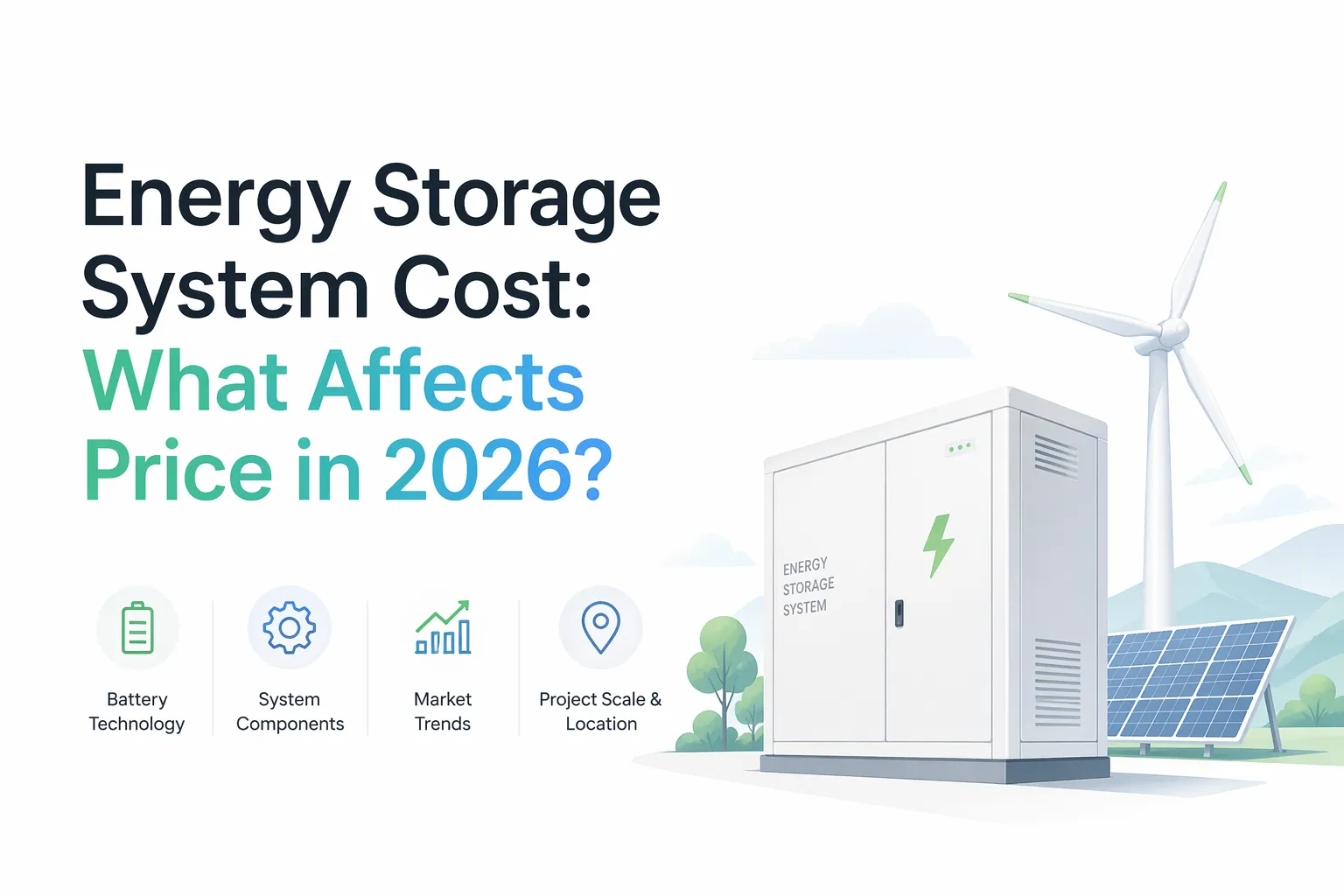
Le coût d'un système de stockage d'énergie est l'une des premières questions que les acheteurs posent en 2026, mais il n'existe pas de prix fixe unique. Un projet de stockage d'énergie par batterie peut varier considérablement en fonction de la chimie, de la capacité utilisable, de la puissance, des conditions d'installation et du niveau d'intégration requis.
Que vous planifiez un système de sauvegarde résidentiel, un projet de réduction de la demande commerciale, ou une mise à niveau de gestion de l'énergie industrielle, comprendre les principaux facteurs de coût vous permet de comparer les devis plus précisément et d'éviter de sous-estimer le budget total du projet. Cet article détaille les principaux facteurs qui influencent les prix du stockage d'énergie en 2026.
1. Chimie des batteries et qualité des cellules
La chimie des batteries reste le principal facteur de coût dans la plupart des projets de stockage. En 2026, le phosphate de lithium fer (LFP) continue de dominer de nombreuses applications stationnaires en raison de son bon équilibre entre sécurité, durée de vie et coût total. D'autres chimies peuvent encore être sélectionnées pour des exigences de performance spécifiques, mais elles comportent souvent des prix et des compromis d'exploitation différents.
La qualité des cellules est également importante. Deux systèmes ayant la même capacité nominale peuvent différer considérablement en prix en raison de différences en termes de réputation de la marque, de cohérence de la fabrication, de taux de dégradation, de stabilité thermique et de garantie. Les acheteurs qui se concentrent uniquement sur le prix initial le plus bas risquent de se retrouver avec un système qui fournit moins d'énergie utilisable au fil du temps.
2. Capacité et puissance du système
Le prix du stockage est influencé à la fois par la capacité énergétique, généralement mesurée en kWh ou MWh, et par la puissance de sortie, généralement mesurée en kW ou MW. Un système conçu pour un stockage d'énergie sur une longue période ne sera pas facturé de la même manière qu'un système optimisé pour de courtes périodes de forte puissance.
En général, les systèmes plus importants bénéficient de l'effet d'échelle, mais le coût total du projet augmente toujours avec l'augmentation de la capacité. Les acheteurs devraient donc évaluer le prix non seulement en fonction du montant total, mais aussi en fonction de métriques spécifiques à l'application, telles que le coût par kWh utilisable, le coût par kW et le débit attendu sur toute la durée de vie.
Pourquoi la surdimensionnement peut entraîner des coûts cachés
Une batterie trop grande, sans tenir compte du profil de charge réel, peut entraîner une augmentation des dépenses liées aux étagères, aux onduleurs, aux câbles, à la protection incendie et à l'espace au sol, sans générer de rendements proportionnels. La dimensionnement correct du système est l'une des façons les plus simples de contrôler les coûts de stockage en 2026.
3. Composants de l'onduleur, du PCS et de l'ensemble du système
La batterie elle-même ne représente qu'une partie du budget. Les systèmes de conversion d'énergie, les systèmes de gestion de batterie, les contrôles EMS, les transformateurs, l'équipement de combinaison, le câblage, les équipements de protection et les plateformes de surveillance contribuent tous au coût final. Dans certains projets, ces systèmes de support représentent une part importante de l'investissement total.
Des onduleurs ou unités PCS de meilleure performance peuvent améliorer l'efficacité et le contrôle, mais elles augmentent également le coût initial. Les acheteurs devraient comparer non seulement les prix de l'équipement, mais aussi l'adéquation technique entre le système de stockage et les besoins opérationnels réels du site.
4. Complexité de l'installation et conditions du site
Le coût d'installation peut varier considérablement d'un site à l'autre. Une installation commerciale standard en intérieur est très différente d'un projet industriel à l'extérieur qui nécessite des systèmes conteneurisés, des fondations spéciales, des améliorations de ventilation, des travaux de raccordement au réseau, ou une protection supplémentaire contre les intempéries.
- L'espace d'installation limité peut nécessiter des mises en page personnalisées.
- Les climats difficiles peuvent nécessiter une gestion thermique ou une protection accrue de l'enclosure.
- Les sites distants peuvent entraîner une augmentation des coûts logistiques et de mise en service.
- Les exigences complexes de raccordement au réseau peuvent entraîner des coûts supplémentaires liés à l'ingénierie et à l'approbation.
Ces conditions spécifiques au projet expliquent souvent pourquoi deux devis pour une taille de batterie similaire peuvent paraître très différents.
5. Exigences de sécurité et de conformité
En 2026, le respect des normes de sécurité est une partie de plus en plus importante du coût des systèmes de stockage d'énergie. Les projets peuvent nécessiter des systèmes de lutte contre l'incendie, de détection de gaz, de surveillance thermique, des systèmes d'arrêt d'urgence et le respect des normes électriques et de construction locales. Les acheteurs commerciaux et industriels ne devraient pas considérer ces éléments comme des options supplémentaires.
Les systèmes avec un meilleur support de certification et une documentation plus complète peuvent coûter plus cher au départ, mais ils peuvent réduire les délais d'approbation, les problèmes liés à l'assurance et les risques à long terme.
6. Garantie, durée de vie et valeur à long terme
Un prix d'achat inférieur ne signifie pas toujours un coût réel inférieur. Les conditions de garantie, les garanties de performance, la durée de vie prévue et les performances de dégradation ont un impact direct sur l'économie globale du projet. Un système avec de meilleures performances à long terme peut offrir un coût de stockage plus faible, même si le prix initial est plus élevé.
Lors de la comparaison de fournisseurs, les acheteurs devraient examiner la capacité utilisable après dégradation, les conditions de garantie, la réactivité des équipes après-vente, et la disponibilité du support technique. Ces facteurs deviennent souvent critiques après la mise en service.
7. Demande du marché, matières premières et pression sur la chaîne d'approvisionnement
Le prix du stockage d'énergie en 2026 est toujours influencé par la demande mondiale, les tendances des lithium et des autres matières premières, les conditions de transport et les changements de politiques régionales. Bien que les coûts des batteries soient devenus plus compétitifs dans de nombreux segments, les prix peuvent encore évoluer en raison des contraintes de la chaîne d'approvisionnement, des changements de politiques énergétiques ou des changements soudains dans la demande de projets.
Pour cette raison, les acheteurs devraient demander des devis avec des périodes de validité claires et vérifier si les prix comprennent les frais de transport, les taxes, les frais de mise en service et les services de support.
Comment réduire le coût d'un système de stockage d'énergie sans compromettre la qualité
- Correspondre la taille de la batterie au profil de charge réel et aux objectifs commerciaux.
- Comparer le coût total d'installation, et non seulement le prix du module de batterie.
- Examine attentivement les conditions de garantie et les hypothèses concernant les performances sur toute la durée.
- Choisissez des fournisseurs ayant une solide expérience en ingénierie et un support après-vente.
- Confirmer la conformité locale et les exigences du réseau dès le début du projet.
Ces étapes peuvent éviter des refontes coûteuses et améliorer le retour sur investissement.
Conclusion
Le coût d'un système de stockage d'énergie en 2026 est influencé par bien plus que le simple prix des batteries. La chimie, la capacité utilisable, le choix de l'onduleur, l'environnement d'installation, la conformité aux normes de sécurité et la qualité des fournisseurs ont tous un impact sur le budget final du projet. Les acheteurs qui comprennent ces variables peuvent prendre de meilleures décisions d'achat et obtenir une valeur plus importante à long terme de leur investissement en stockage.
Si vous évaluez un projet ESS, l'approche la plus efficace est de comparer les solutions en fonction de leur adéquation aux besoins, de leur valeur tout au long de leur cycle de vie et de leur coût total d'installation, plutôt que de se contenter de la meilleure offre.
Pour connaître les spécifications et les configurations actuelles, consultez le site web de Luminvolt. solutions pour le stockage d'énergie sur les gammes de conteneurs, de meubles et de logements.