
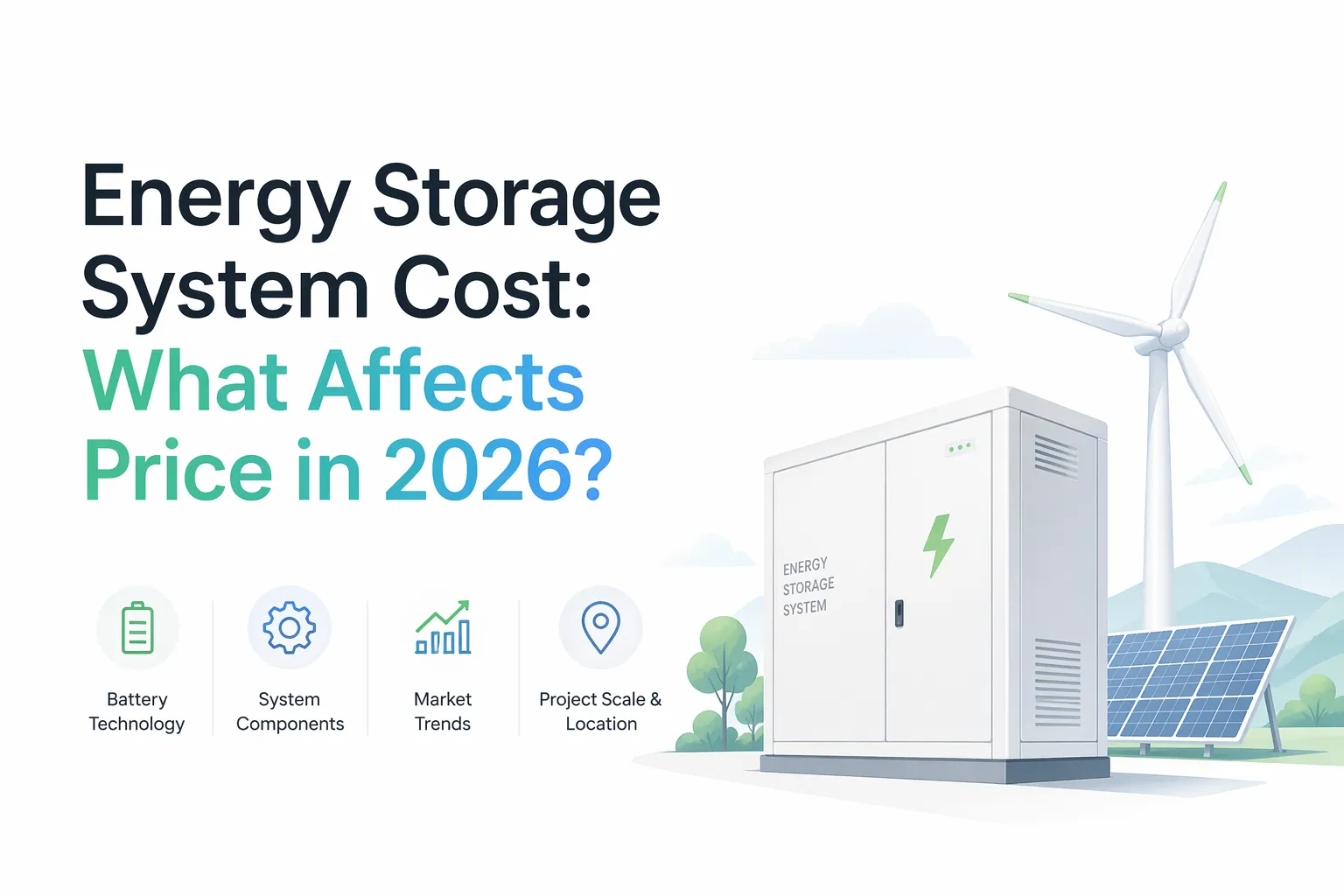
Energy storage system cost is one of the first questions buyers ask in 2026, but there is no single fixed price. A battery energy storage project can vary widely depending on chemistry, usable capacity, power rating, installation conditions, and the level of integration required.
Whether you are planning a residential backup system, a commercial peak-shaving project, or an industrial energy management upgrade, understanding the main cost drivers helps you compare quotations more accurately and avoid underestimating the full project budget. This article breaks down the key factors that affect energy storage pricing in 2026.
1. Battery Chemistry and Cell Quality
Battery chemistry remains the largest cost factor in most storage projects. In 2026, lithium iron phosphate (LFP) continues to dominate many stationary applications because it offers a good balance of safety, cycle life, and total cost. Other chemistries may still be selected for specific performance requirements, but they often come with different pricing and operating trade-offs.
Cell quality also matters. Two systems with the same nominal capacity may differ significantly in price because of differences in brand reputation, manufacturing consistency, degradation rate, thermal stability, and warranty backing. Buyers who focus only on the lowest upfront price may end up with a system that delivers lower usable energy over time.
2. System Capacity and Power Rating
Storage pricing is affected by both energy capacity, usually measured in kWh or MWh, and power output, usually measured in kW or MW. A system designed for long-duration energy shifting will not be priced the same as a system optimized for short bursts of high power.
In general, larger systems benefit from economies of scale, but total project cost still rises as capacity increases. Buyers should therefore evaluate price not only by total amount, but also by application-specific metrics such as cost per usable kWh, cost per kW, and expected lifetime throughput.
Why oversizing can raise hidden costs
Oversizing the battery without matching the actual load profile may increase spending on racks, inverters, cables, fire protection, and floor space without delivering proportional returns. Proper system sizing is one of the easiest ways to control storage cost in 2026.
3. Inverter, PCS, and Balance of System Components
The battery itself is only part of the budget. Power conversion systems, battery management systems, EMS controls, transformers, combiner equipment, cabling, switchgear, and monitoring platforms all contribute to the final cost. In some projects, these supporting systems account for a substantial share of total investment.
Higher-performance inverters or PCS units may improve efficiency and controllability, but they also increase upfront cost. Buyers should compare not just equipment prices, but the technical fit between the storage system and the site’s real operating requirements.
4. Installation Complexity and Site Conditions
Installation cost can vary dramatically from one site to another. A standard indoor commercial installation is very different from a remote outdoor industrial project that requires containerized systems, special foundations, ventilation upgrades, grid interconnection work, or additional weather protection.
- Limited installation space may require customized layouts.
- Harsh climates may require thermal management or stronger enclosure protection.
- Remote sites may increase logistics and commissioning expenses.
- Complex grid connection requirements may add engineering and approval costs.
These project-specific conditions often explain why two quotations for a similar battery size can look very different.
5. Safety and Compliance Requirements
In 2026, safety compliance is an increasingly important part of energy storage system cost. Projects may require fire suppression, gas detection, thermal monitoring, emergency shutdown systems, and compliance with local electrical and building standards. Commercial and industrial buyers should not treat these as optional extras.
Systems with stronger certification support and more complete documentation may cost more upfront, but they can reduce approval delays, insurance friction, and long-term risk.
6. Warranty, Cycle Life, and Long-Term Value
A lower purchase price does not always mean a lower real cost. Warranty terms, throughput guarantees, expected cycle life, and degradation performance have a direct impact on lifetime project economics. A system with better long-term performance may deliver a lower levelized storage cost even if the initial quotation is higher.
When comparing suppliers, buyers should look at usable capacity after degradation, warranty conditions, response from after-sales teams, and the availability of technical support. These factors often become critical after commissioning.
7. Market Demand, Raw Materials, and Supply Chain Pressure
Energy storage pricing in 2026 is still influenced by global demand, lithium and other raw material trends, shipping conditions, and regional policy changes. While battery costs have become more competitive in many segments, pricing can still move due to supply chain constraints, energy policy shifts, or sudden changes in project demand.
For this reason, buyers should request quotations with clear validity periods and check whether prices include freight, taxes, commissioning, and support services.
How to Reduce Energy Storage System Cost Without Sacrificing Quality
- Die Batteriegröße muss auf das tatsächliche Lastprofil und die geschäftlichen Ziele abgestimmt werden.
- Nicht nur den Preis des Batteriemoduls, sondern die Gesamtkosten des Systems vergleichen.
- Die Garantiebedingungen und Annahmen über die Lebensdauer sorgfältig überprüfen.
- Lieferanten mit bewährter Ingenieurkunst und After-Sales-Unterstützung wählen.
- Frühzeitig die lokale Konformität und Netzansprüche bestätigen.
Diese Schritte können teure Neuentwürfe verhindern und die Rendite des Investements verbessern.
Schlussfolgerung
Der Energiekosten für Speichersysteme im Jahr 2026 wird von viel mehr als nur dem Batteriepreis beeinflusst. Chemie, nutzbare Kapazität, Auswahl des Wechselrichters, Installationsumgebung, Sicherheitskonformität und Lieferantenqualität beeinflussen das endgültige Projektbudget. Käufer, die diese Variablen verstehen, können bessere Kaufentscheidungen treffen und einen stärkeren langfristigen Wert aus ihrer Speicherinvestition ziehen.
Wenn Sie ein ESS-Projekt bewerten, ist der beste Ansatz, Lösungen auf der Grundlage der Anwendungsgeeignetheit, Lebenszykluswert und Gesamtkosten zu vergleichen, anstatt nach dem niedrigsten Preisangebot zu jagen.